Silicon carbide: the material, the Acheson process and its uses
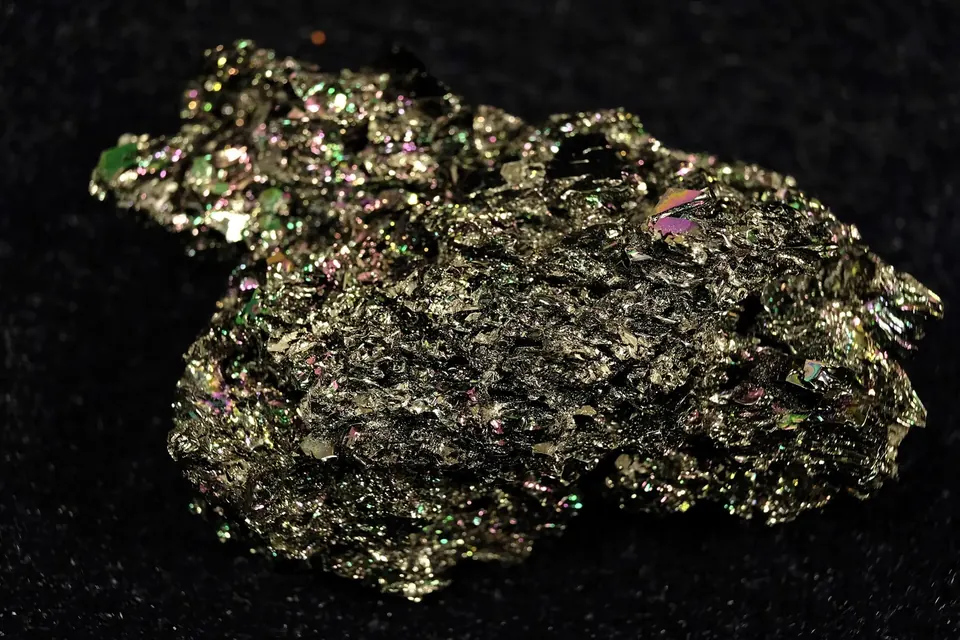
Silicon carbide (SiC) is a compound of silicon and carbon: extremely hard, heat-resistant and chemically robust. In nature it occurs only rarely, as the mineral moissanite. Almost all industrial SiC is synthetic, most of it made by a process more than 130 years old.
The discovery
In 1891, while heating a mixture of clay and carbon electrically, Edward Goodrich Acheson obtained hard, shiny crystals. He called them "carborundum", believing them to be a compound of carbon and alumina (corundum); in fact they were silicon carbide. US Patent 492,767 on the production process was granted in 1893 (Lemelson-MIT; Edward Goodrich Acheson).
The Acheson process
Raw materials and reaction
The inputs are a carbon source, usually petroleum coke, and quartz sand. In simplified form, silicon dioxide reacts with carbon to form silicon carbide and carbon monoxide:
SiO2 + 3 C → SiC + 2 COA European patent gives this overall equation and explains that the reaction starts above 1500 °C, first forming cubic β-SiC, with hexagonal α-SiC forming by recrystallisation above roughly 1800 °C (EP 0 766 645 B1). The producer Fiven gives a process temperature range of about 1700 to 2500 °C (Fiven, "SiC production process").
The furnace
The Acheson furnace is an electrical resistance furnace. A graphite core runs through the middle of a long bed of sand and coke and is connected to electrodes at both ends. Current flows through the core and heats it; SiC grows around it as a cylindrical block. After cooling, the block shows radial zones, from inside out: graphite, coarse crystalline α-SiC as the highest-grade zone, β-SiC, metallurgical grade and unreacted material (Fiven).
From block to grit
The block is sorted, and the crude material is crushed, classified, milled further where required and chemically treated if needed until it meets specification. Only this processing produces the standardised grits used in slurries.
Green and black SiC
Depending on the purity of the raw materials, the result is green or black silicon carbide (Fiven). Purer inputs give the purer green material, less pure inputs the black; a US patent describes this relationship and notes that green SiC commands considerably higher prices (US 4,419,336). In Japanese grit designations such as "GC#1000", GC stands for green silicon carbide.
Why SiC works as an abrasive
- Hardness: SiC is much harder than silicon and one of the hardest industrially produced materials; diamond, its competitor on diamond wire, is harder still.
- Brittle, sharp fracture: crushing yields angular grains that cut well; wear creates new edges, but also fines.
- Chemical resistance: the grain largely survives glycol, water and the alkalis and acids used in reprocessing, which is a precondition for recovering it.
- Availability: the Acheson process delivers large volumes at acceptable cost.
Why recovery makes particular sense
The Acheson process draws all its energy from electrical resistance heating of a graphite core at roughly 1700 to 2500 °C (Fiven). Crushing, milling, classifying and possibly chemical treatment follow before a furnace block becomes a standard micro grit. Every SiC grain that survives sawing intact and returns to the loop through reprocessing replaces one that would otherwise have to travel that whole route again. Alongside cost, this is one of the reasons the literature gives for slurry reprocessing (Murthy 2015). It also links SiC to the wider question of industrial electricity prices in Europe.
Production also shows the limit: fines and broken grains from sawing cannot be "reassembled" into coarse grit. They leave the loop and, depending on purity, go to less demanding uses or to disposal.
Other uses
Besides abrasives and cutting media, SiC is used as an advanced ceramic (mechanical seals, kiln furniture, furnace parts, armour plates), as a refractory and in metallurgy. Fiven cites its hardness and resistance to wear and heat for use as an abrasive and as a ceramic under extreme conditions. A different world entirely is single-crystal SiC as a semiconductor for power electronics, grown not in an Acheson furnace but from the vapour phase; see SiC in power electronics.
Occupational health
In Volume 111 of its Monographs (2017), the International Agency for Research on Cancer (IARC) classified fibrous silicon carbide as possibly carcinogenic to humans (Group 2B), silicon carbide whiskers as probably carcinogenic (Group 2A), and occupational exposures in Acheson production as carcinogenic (Group 1) (IARC Monographs Vol. 111). For SiC powders, dust control and the supplier's safety data sheet are the reference.
 Silicon Carbide
SiC in power electronics
Why 4H-SiC suits power semiconductors, and why sawing its very hard crystals is a discipline of its own.
 Slurry & Recovery
What a sawing slurry is made of
SiC grit, polyethylene glycol and additives: what each component does and how the slurry wears out.
 Industry & Policy
Critical raw materials and silicon
Silicon metal, gallium and germanium under the EU Critical Raw Materials Act: benchmarks, permits and supply risk.