Slurry reprocessing: how silicon carbide and glycol are recovered
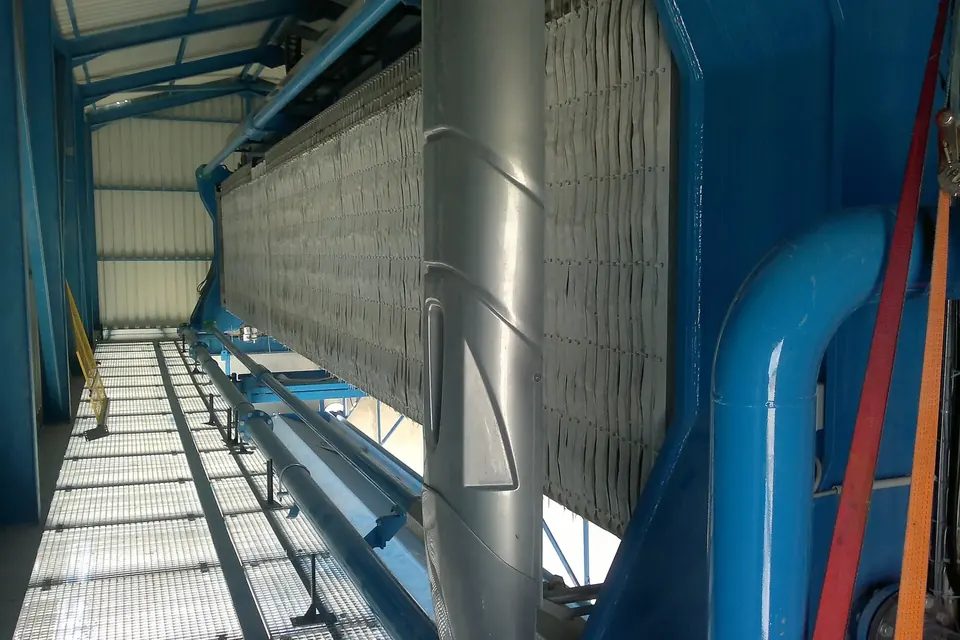
Reprocessing spent sawing slurry has two goals: freeing the still-sharp silicon carbide grains from fines, silicon and metal, and cleaning the glycol so it can serve as carrier again. Plants differ, but the unit operations are the same.
Starting point
A used slurry holds intact SiC grains, broken and rounded fines, very fine silicon kerf, iron from the wire and a glycol phase that has taken up water (see why sawing slurry is recycled). The key difference between the solids is size: silicon kerf is much finer than usable grit. Almost every process therefore begins by separating by particle size and settling velocity.
Murthy's review gives a systematic overview of proposed processes, their physical basis, pros and cons, and selection criteria (Resources, Conservation & Recycling 104, 2015). The steps below summarise the operations that recur in this literature and in patents.
Step 1: solid-liquid separation
First, much of the liquid is separated from the solids. Options include sedimentation (thickeners, gravity classifiers), centrifuges, hydrocyclones and filtration. A reprocessing patent names exactly these and stresses separating as much SiC as possible without significant silicon losses (EP 2 274 767 A2).
A patent with a 2005 priority date gives a concrete sequence: a solid-liquid centrifuge splits the undiluted slurry into a solids-rich fraction holding grains above about 2 µm and a liquid fraction containing most of the glycol and the fine solids (US 8,512,577 B2).
Step 2: classifying the grit
Hydrocyclones
A hydrocyclone is a conical vessel with no moving parts. The suspension enters tangentially and spins rapidly. Heavy, coarse particles are thrown to the wall and leave at the bottom (underflow); fine, light particles join the rising inner vortex with most of the liquid and exit at the top (overflow). The cut size depends on geometry, pressure, viscosity and solids content.
Because one cyclone does not separate sharply, several are run in series. In the US patent above, the solids-rich fraction passes through a battery of hydrocyclones (or centrifuges) in series; clarified liquid is added counter-currently at the last stage, and each underflow feeds the next. The result is a grit suspension largely free of SiC fines. The European patent also notes that cyclones effectively separate most of the coarse SiC.
Centrifuges and decanters
Centrifuges use the same principle of accelerated settling with a rotating bowl. They reach higher accelerations than a cyclone and suit finer cuts and clarifying the liquid. The mix of cyclones and centrifuges in a plant depends on throughput, required sharpness of separation and energy use.
Goal of classification
The recovered SiC fraction should again have a size distribution matching a standard grit. Missing coarse grain is topped up with fresh grit; fines, meaning broken grit and silicon, are discharged.
Step 3: cleaning the grit
After classification, glycol, silicon dust and metal still cling to the grains. The US patent describes a sequence in a single pressure vessel: pressure filtration, hot washing with recovered water, alkaline etching with sodium or potassium hydroxide to remove fine silicon, washing, acid etching to remove metal particles, washing again and hot-air drying. It gives 85 to 95 % yield of reusable grit. That is a patent figure, not an independently measured industry value.
Iron can also be removed magnetically. The European patent describes magnetic separation of steel particles from the SiC-depleted suspension, followed by acid leaching of residual metals.
Safety note: in alkaline etching, silicon reacts and releases hydrogen. Plants treating silicon fines with caustic or water need gas detection, ventilation and explosion protection.
Step 4: recovering the glycol
The liquid fractions contain glycol, water, dissolved and colloidal matter, fine solids and metal. Recovery typically runs in three stages:
- Clarification: fine filtration or microfiltration removes residual solids. A patent warns that membranes clog quickly on untreated slurry, so pre-treatment is needed (US 8,734,751).
- Metal removal: in US 8,512,577 the liquid is either made alkaline so iron precipitates as hydroxide and can be filtered, then neutralised, or passed through cation and anion exchangers.
- Dewatering: glycol boils at a much higher temperature than water, so water can be evaporated, leaving dewatered glycol. The patent again gives 85 to 95 % recovery.
Recovered glycol is checked for water content and viscosity, blended with fresh glycol if needed and mixed with grit into slurry again.
Step 5: re-blending and testing
The reprocessed slurry must meet the saw's specification. Typical tests cover particle size distribution, density, viscosity, water content and metal content. Only then does the slurry go back to the saw.
Unit operations at a glance
| Operation | Separates by | Typical purpose |
|---|---|---|
| Sedimentation, thickener | Settling velocity | Pre-concentration, clarification |
| Hydrocyclone | Size and density in a centrifugal field | Classifying SiC grit, removing fines |
| Centrifuge | Settling velocity at high acceleration | Solid-liquid separation, fine cuts |
| Filtration, microfiltration | Particle size at the filter medium | Clarifying glycol, dewatering grit |
| Magnetic separation | Magnetic properties | Removing steel debris |
| Leaching, etching | Chemical reactivity | Removing silicon (alkaline) and metal (acid) |
| Evaporation, distillation | Boiling point | Removing water from glycol |
| Ion exchange | Charge of dissolved ions | Removing dissolved metals from glycol |
For what remains after reprocessing, above all the silicon kerf, see kerf loss and silicon recovery.
 Slurry & Recovery
Why spent slurry is recycled
Cost, EU waste law and resource value: the case for reusing silicon carbide and glycol, and its limits.
 Slurry & Recovery
Kerf loss and silicon recovery
How much silicon is lost in the cut, why it is hard to win back and which recovery routes research describes.
 Slurry & Recovery
What a sawing slurry is made of
SiC grit, polyethylene glycol and additives: what each component does and how the slurry wears out.